

Introduction: The Art of the Smart 48-Hour Escape
Life moves fast, and sometimes the only thing standing between you and complete burnout is a well-deserved 48-hour break. For millions of travelers looking for weekend trip ideas, the traditional two-week annual vacation is no longer the only way to satisfy wanderlust. Micro-vacations and quick two-day escapes have become the ultimate way to recharge, explore new cultures, and break up the monotony of daily life without draining your bank account.
However, a common misconception plagues modern travel culture: the belief that a great trip requires a massive budget, months of meticulous planning, and expensive flights to exotic international hotspots.Truth is, that’s just a myth. Many of the most memorable, stress-free, and culturally rich trips happen just a couple of hours from home without hurting your wallet.
If you have been searching for weekend trip ideas that genuinely deliver high value, deep local immersion, and strict financial control, this comprehensive global guide is built for you. Whether you live in bustling North American urban centers, historic European cities, vibrant Asian metropolises, or Latin American landscapes, this guide will walk you through everything you need to know to execute a flawless, budget-friendly weekend escape.
1. Understanding the Psychology and Economics of Budget Weekend Travel
Before diving into specific destinations and conceptual frameworks, it is vital to understand why weekend trips often fail financially and how you can hack the system.
When people plan a weekend trip, they frequently fall into the “Urgency Trap.” Because a weekend is only 48 hours long, travelers panic. They book high-speed flights, expensive airport taxis, luxury central hotels, and premium tourist-trap restaurants to maximize every single minute. By Sunday evening, they return home exhausted, broke, and nursing a severe financial hangover.
Planning smart weekend trip ideas relies on a completely different philosophy: Micro-Leverage. Instead of spending 40% of your time and 60% of your budget on transit, you optimize your logistics. You focus on nearby geographic radiuses, alternative accommodations, and authentic local experiences that cost little to nothing.
The Financial Architecture of a 2-Day Trip
To keep costs low, you must break your expenses down into four non-negotiable pillars:
- Transportation (Target: 20% of total budget): Utilizing regional transit, fuel-sharing, or buses rather than planes or private cabs.
- Accommodation (Target: 40% of total budget): Securing clean, safe, alternative lodging like boutique hostels, guesthouses, or nature cabins.
- Food & Sustenance (Target: 30% of total budget): Balancing grocery store exploration with one authentic local sit-down meal per day.
- Activities (Target: 10% of total budget): Prioritizing nature, free walking tours, public spaces, and open-air heritage sites over paid entry ticket.
2.Top Budget Weekend Trip Ideas (Worldwide Frameworks)

Concept A: National Parks, State Reserves, and Wilderness Escapes
Instead of listing a few specific cities that may be thousands of miles away from you, let’s explore five globally adaptable weekend trip ideas and concepts.Nature does not charge admission fees, and some of the most breathtaking landscapes on the planet are completely free to enter or cost a negligible parking fee.
- The Global Appeal: Whether it is exploring the green rolling hills of the Peak District in the UK, hiking the rugged Blue Mountains in Australia, visiting regional state parks in North America, or discovering the Western Ghats in India, nature offers infinite weekend potential.
- Why It Saves Money: Accommodation near national parks usually consists of rustic cabins, campsites, or small family-run guesthouses, which are exponentially cheaper than luxury downtown hotels. Families looking for affordable destinations and memorable experiences can also explore our guide to best family vacations on a budget for more travel inspiration. Furthermore, entertainment costs drop to zero because your main activity is hiking, trail-walking, or wildlife viewing.
- Execution Strategy: Pack a lightweight camping stove or a cooler stocked with basic grocery items. Eating meals surrounded by mountains or forests not only saves money but enhances the sensory experience of the trip.
Concept B:Off-Peak Coastal Weekend Trip Ideas

Coastal towns and lakeside destinations are notorious for price gouging during peak summer or winter holiday seasons. However, the exact same destinations transform into budget paradises just a few weeks before or after the rush. For more inspiration on planning a seasonal getaway, explore our guide to summer vacation ideas for destination ideas and helpful travel tips.
- The Global Appeal: Think of the Algarve in Portugal during late autumn, coastal stretches of Southeast Asia during the transition months, or lakeside towns in North America during early spring and late fall.
- Why It Saves Money: Hoteliers and vacation rental owners experience steep drops in occupancy during shoulder seasons. They slash room rates by 30% to 60% just to keep rooms filled. You get the exact same beach, the exact same ocean breeze, and the exact same scenic views for a fraction of the cost.
- Execution Strategy: Research the regional climate patterns of your chosen coastal destination to identify the exact window where weather remains pleasant while tourist crowds vanish. Always look for properties equipped with kitchenettes to bypass expensive restaurant breakfast bills.
Concept C: Historic Small-Town Heritage Exploration
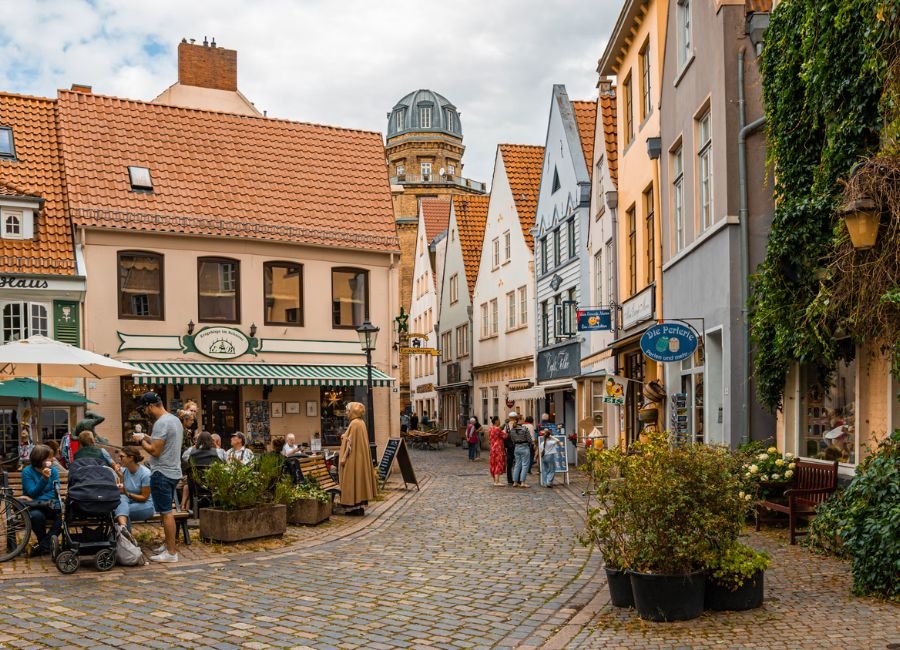
Major global capitals and mega-cities are financial sinkholes. Parking is expensive, hotels are exorbitant, and dining out carries a tourist markup. In contrast, historic small towns offer deep cultural richness on a micro-budget.
- The Global Appeal: Historic market towns in Europe, ancient temple-adjacent suburbs in Japan, colonial towns in Latin America, or heritage towns in Southeast Asia.
- Why It Saves Money: Small towns are inherently walkable, eliminating public transit or rideshare expenses once you arrive. Local markets sell regional delicacies at local prices, and historic architecture, public squares, and local museums often feature free or nominal admission fees.
- Execution Strategy:As soon as you arrive, head straight to the local tourism office or community center. They almost always provide free walking-tour maps, discount booklets, and schedules for local community events that major travel blogs miss entirely. If you prefer exploring new places with an organized group, read our guide to small group travel to learn how shared experiences can make a trip easier to plan.
Concept D: Regional Train & Bus Weekend Trip Ideas
You do not need to board a commercial aircraft to experience urban culture. Exploring a neighboring city using ground transportation unlocks incredible weekend value.
- The Global Appeal: Leveraging extensive railway networks in Europe and Japan, cross-state bus lines like Megabus or Greyhound in North America, or regional coach networks across Latin America and Asia.
- Why It Saves Money: Air travel involves hidden expenses—checked bag fees, airport security delays, expensive airport train/taxi transfers, and pre-flight seating costs. Ground transport drops you directly in the heart of the city center for a flat, predictable fee.
- Execution Strategy: Book your train or coach tickets 3 to 4 weeks in advance during promotional flash sales. Pack light enough to fit everything into a single carry-on backpack, allowing you to walk straight out of the bus or train station and onto local public transit.
Concept E:Micro-Camping and Rustic Cabin Escapes
For adventurous souls, ditching traditional walls and roofs entirely is the ultimate financial hack for weekend travel.
- The Global Appeal: Utilizing public wilderness huts in New Zealand, Scottish mountain bothies, authorized forest service campsites in North America, or eco-friendly glamping pods globally.
- Why It Saves Money: Accommodation costs are reduced to virtually zero or a tiny municipal maintenance fee. This leaves your entire budget open for food, local treats, and minor travel logistics.
- Execution Strategy: Invest once in lightweight, durable gear (tent, sleeping pad, sleeping bag). If purchasing gear is out of your budget, borrow from friends or check out local outdoor gear rental collectives.
3. Global Budget Matrix for Weekend Trip Ideas
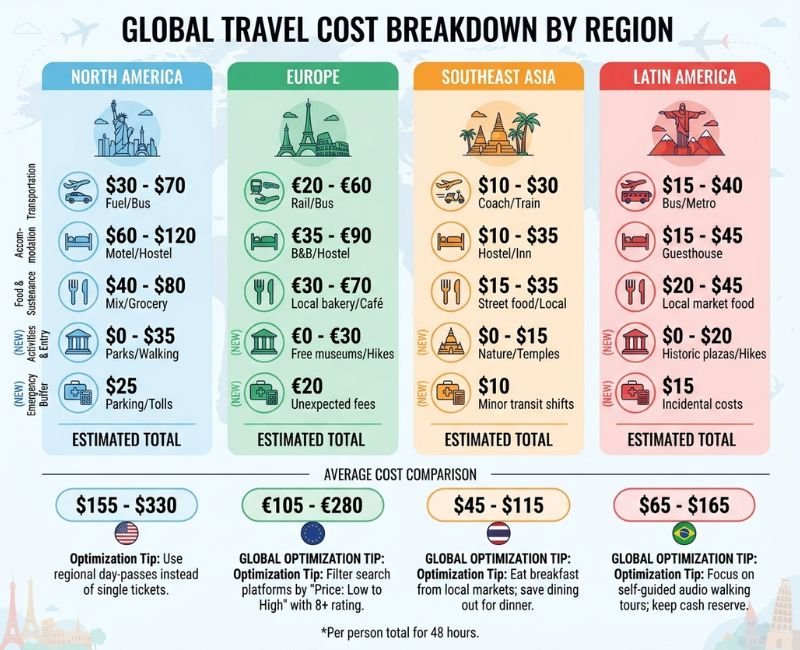
To help you visualize financial allocation across different regions of the world, use the following detailed matrix when planning your 2-day / 1-night escape:
| Expense Category | North America | Europe (Eurozone) | Southeast Asia | Latin America | Global Optimization Tip |
| Transportation | $30 – $70 (Fuel/Bus) | €20 – €60 (Rail/Bus) | $10 – $30 (Coach/Train) | $15 – $40 (Bus/Metro) | Use regional day-passes instead of single tickets. |
| Accommodation | $60 – $120 (Motel/Hostel) | €35 – €90 (B&B/Hostel) | $10 – $35 (Hostel/Inn) | $15 – $45 (Guesthouse) | Filter search platforms by “Price: Low to High” with 8+ rating. |
| Food & Sustenance | $40 – $80 (Mix/Grocery) | €30 – €70 (Local bakery/Café) | $15 – $35 (Street food/Local) | $20 – $45 (Local market food) | Eat breakfast from local markets; save dining out for dinner. |
| Activities & Entry | $0 – $35 (Parks/Walking) | €0 – €30 (Free museums/Hikes) | $0 – $15 (Nature/Temples) | $0 – $20 (Historic plazas/Hikes) | Focus on self-guided audio walking tours and public spaces. |
| Emergency Buffer | $25 (Parking/Tolls) | €20 (Unexpected fees) | $10 (Minor transit shifts) | $15 (Incidental costs) | Always keep a small physical cash reserve separate from cards. |
| Estimated Total | $155 – $330 | €105 – €280 | $45 – $115 | $65 – $165 | Per person total for 48 hours. |
4. 4-Step Blueprint for Executing Weekend Trip Ideas
Execution is everything. Even the best-laid plans can fall apart without a strict structural framework. Follow this 4-step blueprint to take your trip from an abstract idea to an affordable reality:
[ Step 1: The 3-Hour Radius Rule ]
│
▼
[ Step 2: Alternative Lodging Curation ]
│
▼
[ Step 3: The Rule of One Meal Strategy ]
│
▼
[ Step 4: Digital Minimalism & Packing Light ]
Step 1: Apply the 3-Hour Radius Rule
Never select a weekend destination that requires more than 3 hours of transit time in a single direction. If you spend 6 to 8 hours of your precious 48-hour window sitting behind a steering wheel, crammed in a bus, or waiting in a station, physical fatigue sets in, and your trip quality plummets. Draw a 3-hour circle around your home on a map and explore the hidden gems hiding right in your backyard.
Step 2: Alternative Lodging Curation
Never click on luxury chain hotels or generic corporate properties. Instead, use specialized aggregator filters to unearth boutique independent hostels, family-run bed-and-breakfasts, or peaceful farm stays. Always check user reviews carefully to ensure cleanliness and safety, prioritizing properties with a score of 8.0 or higher while maintaining a low price filter.
Step 3:Apply the “Rule of One” to Every Meal
Food is often the silent killer of travel budgets. To control this, adopt the Rule of One: eat one authentic, sit-down meal at a recommended local restaurant to experience the regional culture, and handle your remaining meals via local supermarkets, bakeries, or street food vendors. Stocking up on local fruits, fresh bread, and cheese for a scenic park picnic is frequently much more memorable than sitting in a crowded restaurant anyway.
Step 4: Digital Minimalism and Packing Light
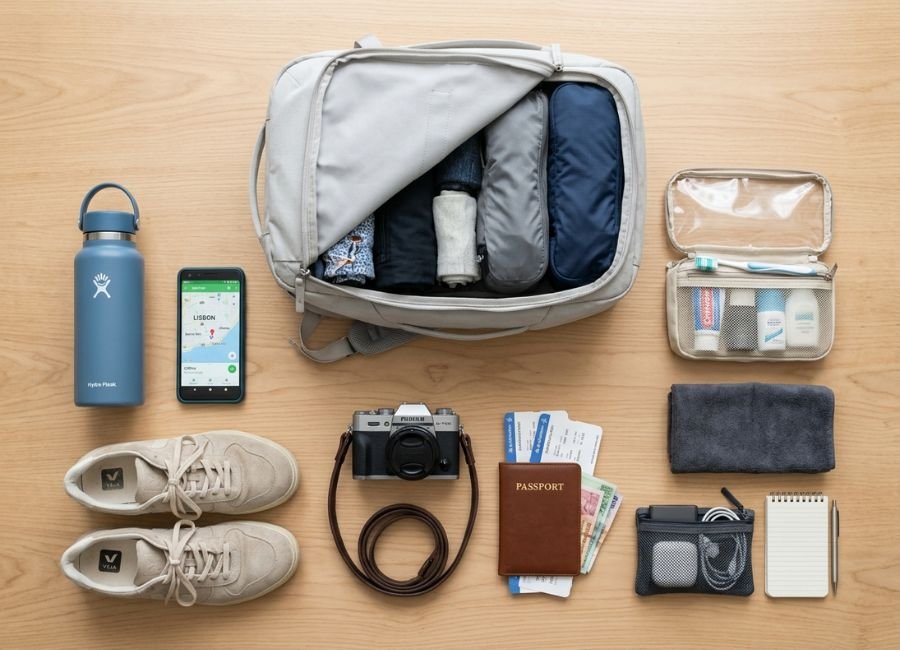
Checked bag fees are an unnecessary tax on modern travelers. Pack everything you need for 48 hours into a single, compact backpack or carry-on bag. Furthermore, practice digital minimalism: download offline maps (using apps like Google Maps or Maps.me) before you leave home to avoid expensive international data roaming charges or emergency connection issues.
5. Advanced Money-Saving Hacks for Weekend Trip Ideas
If you want to take your budget travel game to a professional level, incorporate these lesser-known strategies into your routine:
- The Sunday-Night Stay Hack: If your schedule allows flexibility, booking accommodations for Sunday night instead of Friday night can often slash lodging costs in half, as business travelers and weekenders check out en masse.
- Leverage Mid-Week Flash Sales for Weekend Slots: Regional transport providers (trains and bus lines) frequently drop flash discount codes on Tuesday or Wednesday mornings for upcoming weekend routes. Keep an eye on your favorite transit apps during these windows.
- The Reusable Water Strategy: Buying bottled water throughout your trip can increase both travel expenses and plastic waste. Carry a reusable water bottle and refill it at safe, approved drinking-water stations whenever possible . Invest in an insulated, filtered reusable water bottle to keep hydration costs at absolute zero.
- Ditch Rideshares and Taxis: Skip Uber, Lyft, and local cabs in busy tourist areas they often charge crazy surge prices. Research the local public transit app or rent a municipal bicycle to navigate the city like a local while saving up to 80% on transit fees.
Final Thoughts
Embarking on unforgettable adventures does not require an endless supply of money or months of advance preparation. By executing these smart weekend trip ideas and shifting your mindset toward localized exploration, you unlock a world of affordable possibilities.
The beauty of a weekend trip lies in its spontaneity and simplicity. Armed with the conceptual frameworks, budgeting strategies, and practical blueprints outlined in this guide, you are more than ready to pack a single bag, step outside your comfort zone, and experience your next great adventure without financial stress.
Frequently Asked Questions
- What is the absolute cheapest way to travel for a weekend?
Taking regional public buses or sharing fuel costs for a road trip while staying in budget hostels or camping keeps expenses to an absolute minimum. - How far in advance should I book a budget weekend trip?
Booking regional transport and budget lodging approximately 2 to 3 weeks in advance strikes the ideal balance between low pricing and good availability. - How can I avoid hidden fees on short trips?
Pack light with just a single backpack you’ll skip baggage fees and breeze through transit much faster - Are weekend trips worth it if they are so short?
Yes, frequent 48-hour escapes provide powerful mental resets and cultural exposure without requiring you to take extended time off work. - What is the best way to find cheap food while traveling?
Grab your breakfast and snacks from local street markets or neighborhood grocery stores it cuts your food bill right in half. - Should I use travel agents for weekend trips?
No, planning your own weekend trip using online mapping and regional transit apps saves money and gives you complete control over your itinerary.
Pingback: Best Summer Vacation Ideas for Every Traveler
Pingback: Best Vacations in America for Families: 10 Budget Ideas